
Spray Foam Insulation for Larger Ellicott City Homes, Bonus Rooms, Cathedral Ceilings, and Finished Basements


4.7/5 Customer Rating
Chosen by 100+ homeowners throughout Ellicott City and neighboring areas.
The bonus room over our garage was never usable in summer. They insulated the floor cavity and sealed the rim joists, and now it is the same temperature as the rest of the house.
Priya S.
Ellicott City, MD
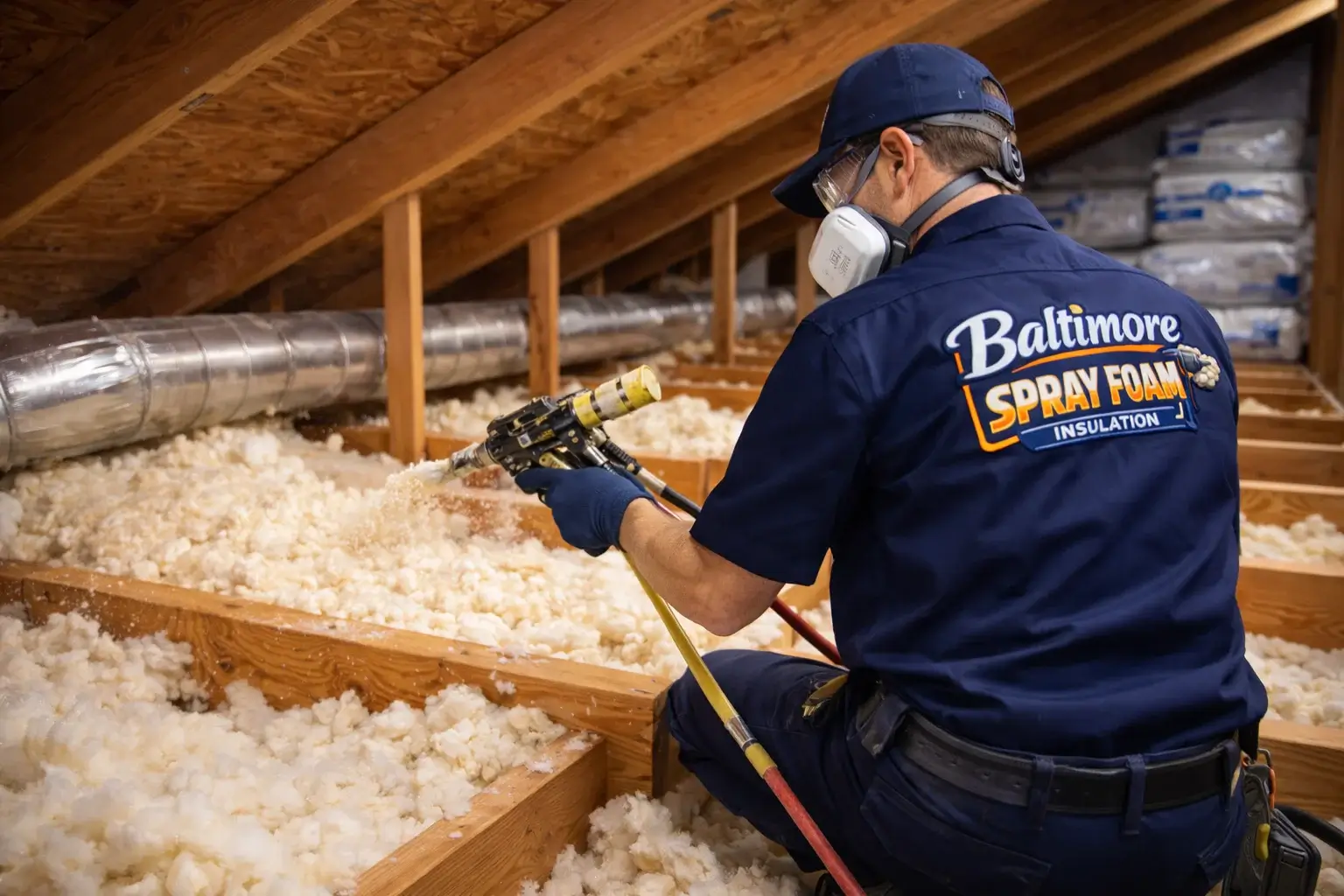
Spray foam insulation in Ellicott City targets the areas where larger homes lose the most conditioned air: bonus rooms over garages, cathedral and tray ceilings, attic access points, and rim joists above finished basements. Bigger homes carry bigger heating and cooling loads, so a small percentage of air leakage costs more here than in a smaller house. Open-cell foam commonly runs $0.60 to $0.90 per board foot, closed-cell $1.00 to $1.50, with most single-area projects between $1,800 and $4,400.
The room over the garage is the most common example. It sits above unconditioned space, with its floor exposed to outside air on three or four sides, and it is usually the furthest point from the air handler. Insulating that floor cavity and sealing its rim joists typically produces a bigger comfort change than anything done in the main attic.
Cathedral and tray ceilings are the second recurring issue. These have shallow cavities with little room for traditional batt insulation, and they are frequently interrupted by recessed lights that act as direct air paths into the attic. As experienced spray foam insulation experts in Baltimore, MD, we size the work to the house rather than applying foam everywhere.
Bigger homes need the envelope mapped before any foam is applied. Here is the sequence.
STEP 1
We map the full conditioned envelope rather than one area, because in larger homes the worst room is usually not the one with the obvious problem. Bonus rooms, cathedral ceilings, and hidden rim joists are checked together.
STEP 2
We rank the work by comfort gain per dollar, so you can do the whole envelope at once or start with the room that bothers you most. Foam type, thickness, and board-foot pricing are confirmed in writing first.
STEP 3
We mask finished spaces carefully, apply the foam, clean the site, and walk you through exactly what was sealed and why.
In larger Ellicott City homes, a single uncomfortable room almost always traces back to a specific gap in the building envelope. Book an assessment and find out which one.
Over 100 Baltimore-area homeowners trust us to seal their homes.

We work throughout Ellicott City, from the historic district along Main Street to the larger developments around Centennial, Turf Valley, and Font Hill. The range here is wide: 19th-century stone and brick buildings in the old town, and substantial late-century and modern colonials everywhere else. Those two extremes need genuinely different work.
In the newer homes, the value is in precision. The house is not badly built, it simply has three or four specific weak points that were never addressed, and fixing exactly those delivers a noticeable change without touching the rest. In the historic district, the approach needs more care around moisture and original framing.
In larger homes the change usually shows up as rooms that finally hold temperature and an HVAC system that stops running constantly. Here is what local homeowners have said.
What Ellicott City homeowners ask before booking insulation work on a larger home.
Spray foam insulation in Ellicott City is priced by board foot: about $0.60 to $0.90 per board foot for open-cell and $1.00 to $1.50 for closed-cell. Most single-area projects such as a bonus room floor or an attic fall between $1,800 and $4,400. Larger whole-home projects cost more because the square footage and foam thickness drive the total.
The room over the garage is uncomfortable because its floor sits above unconditioned space and is exposed to outside air on multiple sides, while also being the furthest point from the air handler. Insulating the floor cavity with closed-cell spray foam and sealing the rim joists usually produces a larger comfort improvement than adding insulation anywhere else in the house.
Yes. Open-cell spray foam applied to the underside of the roof deck is well suited to cathedral and tray ceilings, because those cavities are too shallow for traditional batt insulation to reach a useful R-value. Spray foam also seals around recessed lighting penetrations, which are a common air leak path in these ceilings. Roof ventilation is assessed first so the assembly is designed correctly.
Spray foam can still be worth it in a newer home when specific parts of the envelope were never properly sealed, which is common with bonus rooms, cathedral ceilings, attic hatches, and rim joists above finished basements. Newer homes usually need targeted work rather than whole-home foam, so the assessment identifies the few areas that will actually change how the house feels.
Yes, though access determines the approach. In a finished basement the rim joists sit behind drywall, so the work is easiest during a renovation or where an access panel exists. Closed-cell spray foam is the usual choice because it resists moisture and delivers a higher R-value per inch in the limited space available.
A single area such as a bonus room floor or an attic is usually completed in one day. Whole-home projects across several areas typically take two to three days, depending on square footage, foam thickness, and whether old insulation needs removing. People and pets should stay out of the home during application and for two to four hours afterward while the foam cures.