
Spray Foam Insulation Built Around Catonsville’s Older Homes, Open Wall Cavities, and Cold Basements


4.7/5 Customer Rating
Chosen by 100+ homeowners throughout Catonsville and neighboring areas.
Our 1920s house was impossible to heat evenly. They sealed the attic floor and rim joists instead of just adding more insulation, and the difference was immediate.
Marie L.
Catonsville, MD
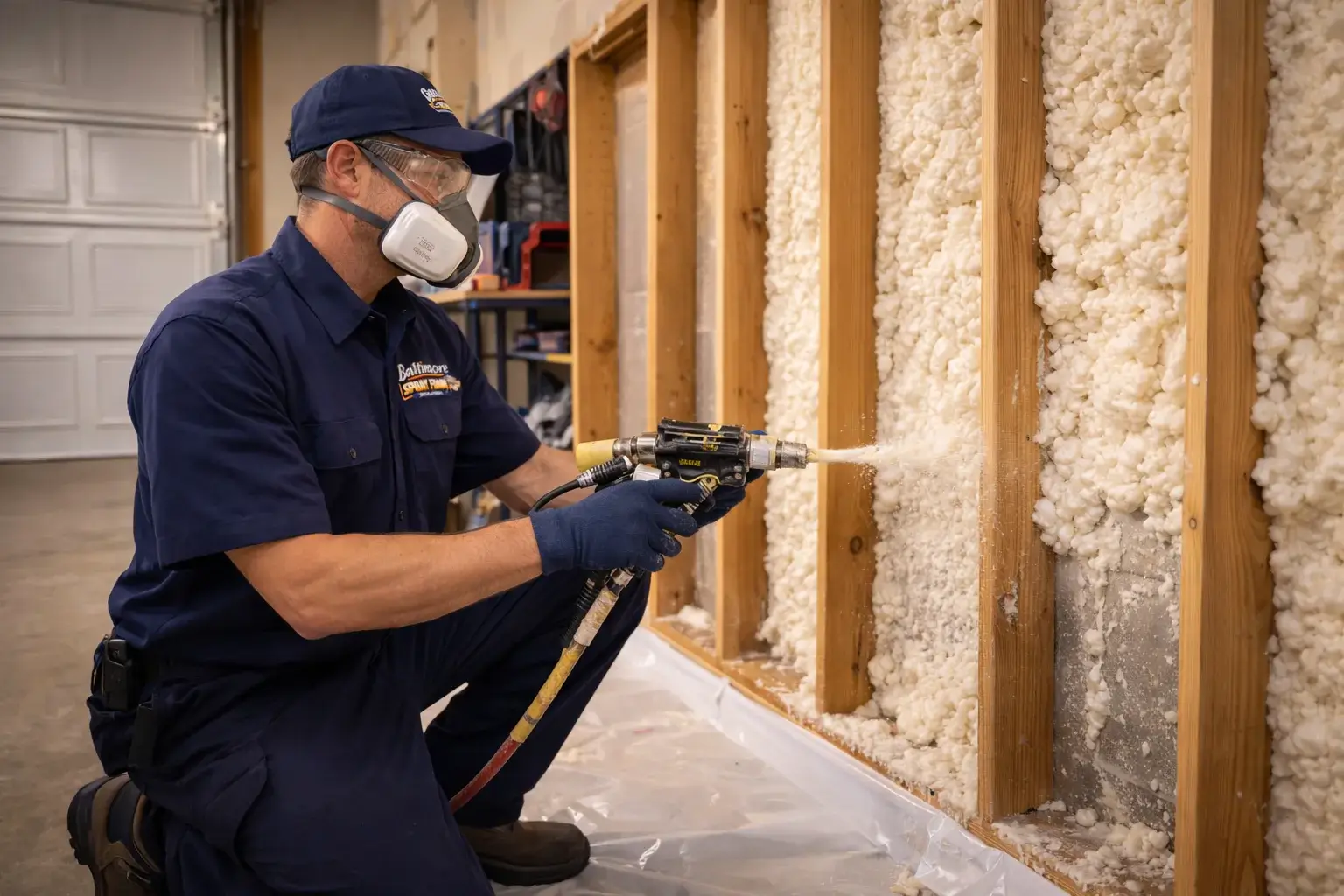
Spray foam insulation in Catonsville seals the air leaks common in older homes, where balloon-framed walls, open attic floors, and uninsulated basements let conditioned air escape year-round. Most Catonsville projects focus on the attic, rim joists, and crawl space, since those areas move the most air in homes built before insulation was standard. Open-cell foam commonly runs $0.60 to $0.90 per board foot and closed-cell $1.00 to $1.50, with most single-area projects between $1,800 and $4,400.
Catonsville homes are harder to insulate than newer construction because many use balloon framing, where wall cavities run uninterrupted from the basement to the attic. That creates a chimney effect: air enters at the foundation, travels up inside the walls, and exits through the attic, carrying heated or cooled air with it.
The historic core around Frederick Road holds Victorians, American four-squares, and 1920s bungalows. Their attics were designed for ventilation rather than energy performance, and their basements were never meant to be conditioned space. Sealing the attic floor and rim joists usually delivers the biggest change without touching the character of the house. Working as the spray foam insulation contractors in Baltimore who handle these older properties, we plan the work around how the house was actually built.
Older houses need a different sequence than new construction. Here is how a Catonsville project runs.
STEP 1
We check the attic, wall cavities, rim joists, and basement or crawl space together, because in balloon-framed homes these areas are connected and sealing only one rarely solves the problem.
STEP 2
We recommend the approach that delivers the biggest air-sealing gain with the least disruption to original finishes, then confirm foam type, thickness, and board-foot pricing in writing.
STEP 3
Older homes need more masking and protection. We seal off the work area, apply the foam, clean thoroughly, and walk you through everything that was sealed.
Homes built before modern insulation standards can lose a large share of conditioned air through the attic and open wall cavities. Book a Catonsville assessment and find out where.
Over 100 Baltimore-area homeowners trust us to seal their homes.

We insulate homes across Catonsville, from the historic streets near Frederick Road and Oella to the newer developments toward Ellicott City and the neighborhoods around Catonsville Middle. Older houses reward a careful approach: aggressive foam application in the wrong cavity can trap moisture in framing that has been drying freely for a century.
That is why the assessment matters more here than in newer construction. We look at how the house was built, where moisture already moves, and which cavities should be sealed versus left ventilated. In many Catonsville homes the correct answer is closed-cell foam at the rim joists and careful air sealing above, not foam everywhere.
Older homes show the difference quickly, especially on the top floor and over unheated basements. Here is what local homeowners have told us.
The questions Catonsville homeowners ask most before starting an insulation project.
Spray foam insulation in Catonsville is priced by board foot: roughly $0.60 to $0.90 per board foot for open-cell and $1.00 to $1.50 for closed-cell. Most single-area projects fall between $1,800 and $4,400. Older Catonsville homes sometimes cost more when old insulation has to be removed first or when attic access is tight.
Spray foam can be used safely in historic homes when the assessment accounts for how the house currently manages moisture. Older framing has usually been drying in both directions for decades, so sealing the wrong cavity can trap moisture. In most Catonsville Victorians and four-squares the safest and most effective approach is sealing the attic floor and rim joists rather than filling every wall cavity.
Balloon framing is a construction method common before the 1930s where wall studs run continuously from the foundation to the roof, leaving open cavities between floors. It matters because those open cavities let air travel straight from the basement to the attic, carrying heated or cooled air with it. Blocking and sealing those cavities is often the single biggest improvement in an older Catonsville home.
Old attic insulation should be removed when it is wet, compressed, moldy, pest-damaged, or hiding air leaks that need sealing. Many Catonsville attics still hold original batts that have lost most of their rated performance. Installing over damaged material hides the problem instead of fixing it, so an inspection confirms whether removal is needed.
Closed-cell spray foam at the rim joists and band joists can reduce drafts and cold transfer in a Catonsville basement, and it resists moisture better than open-cell foam or fiberglass. It does not fix standing water, grading problems, or drainage failures. Those issues should be corrected before or during the insulation work.
Most single-area Catonsville projects finish in one day. Older homes that need old insulation removed, extra masking, or work in more than one area often take two days. We ask that people and pets stay out of the house during application and for two to four hours afterward while the foam cures.